

Blogs make money by attracting the right audience, earning that audience’s trust, and connecting readers with a relevant product, service, or offer.
The publishing itself does not create revenue. You can write hundreds of articles, but if nobody finds them or the visitors have no reason to take action, the blog will struggle to make money.
I currently run two websites that started as blogs. I have built sites from nothing, grown traffic, earned affiliate commissions, and developed relationships with larger brands as the sites became more recognizable within their niches.
My experience has taught me that a good blog is more than a collection of articles. It can become an educational resource, a marketing channel, a conversion platform, and eventually a sellable business.
Here are the main ways blogs make money and how each method fits into the bigger picture.
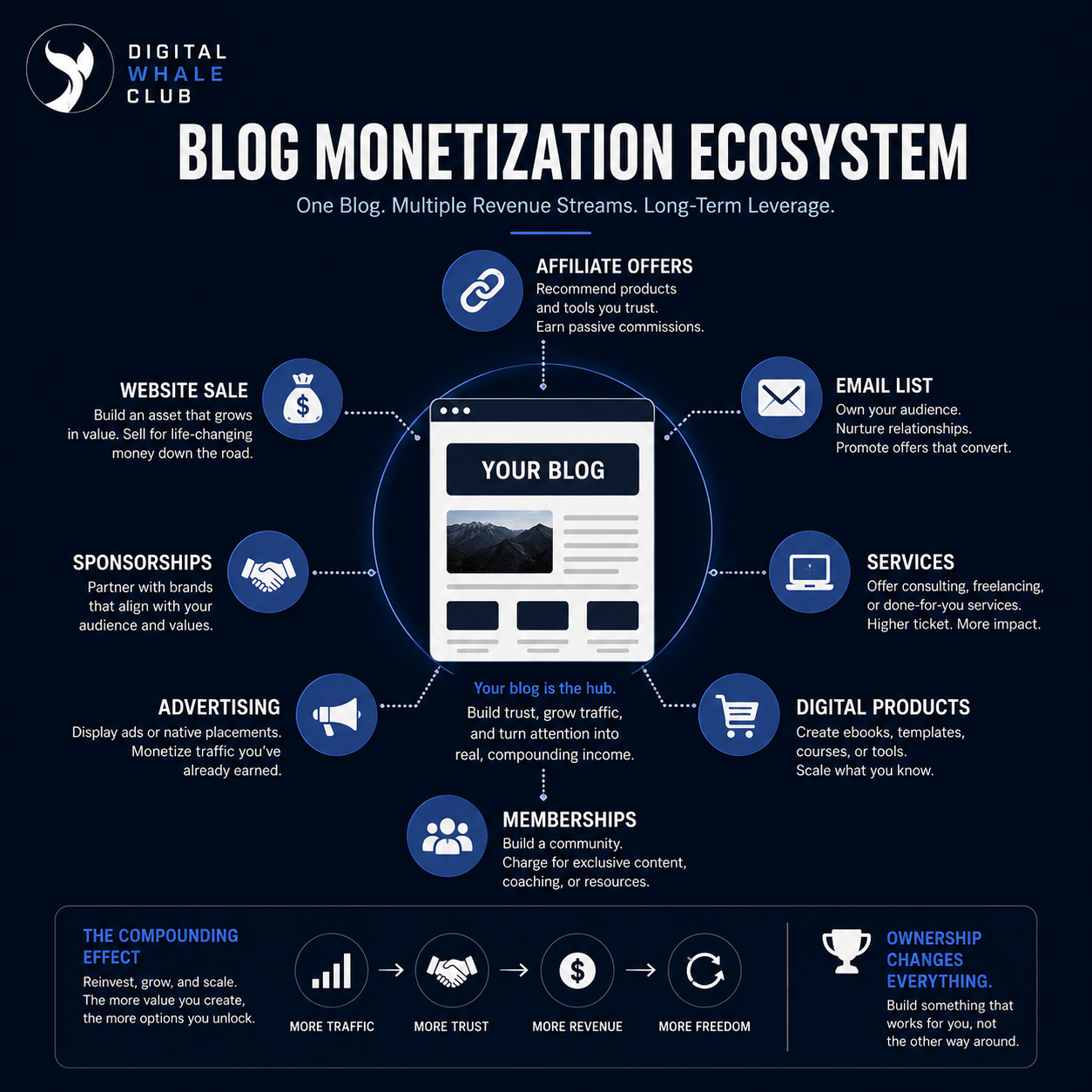
How Do Blogs Actually Make Money?
Most blogging business models have three parts:
- Attract people through Google, YouTube, social media, referrals, or an email list.
- Help them answer a question or make a decision.
- Present a relevant product, service, or next step.
Traffic volume matters, but traffic value matters more.
One hundred readers comparing products they intend to buy may be more valuable than 10,000 visitors reading a broad informational article. The first audience has clear commercial intent. The second might leave without taking any action.
This is why your content strategy and monetization strategy need to work together.
1. Affiliate Marketing
Affiliate marketing is how approximately 99% of the revenue from my websites is currently generated.
A blogger joins a company’s affiliate program, receives a tracked link, and earns a commission when a reader uses that link to make a qualifying purchase.
The types of affiliate content that have converted best for me are:
- Individual product reviews
- Product comparisons
- “Best” product lists
These articles reach people who are already considering a purchase.
My first affiliate commission was approximately $25 to $30, and it came relatively quickly. I was operating in an underserved niche where people had questions that existing websites were not answering particularly well.
For beginners, reviewing products in a niche you understand can be a strong starting point. Individual reviews do not always have the highest search volume, but specific product searches can be easier to rank for than broad, highly competitive topics.
Reviews alone are not enough, though. A well-rounded authority site also needs informational content that answers broader questions, develops topical relevance, and gives readers reasons to trust the brand.
As your site grows, affiliate marketing can lead to direct brand relationships. Once you have generated meaningful revenue for a company, you have more leverage to negotiate higher commissions, request custom offers, receive early product access, and develop longer-term partnerships.
Recurring affiliate commissions are especially valuable. When you promote a subscription product that pays recurring commissions, one customer can continue generating revenue for several months.
2. Digital Products
Blogs can sell ebooks, templates, checklists, guides, spreadsheets, calculators, and other downloadable resources.
Digital products can have strong margins because there is no physical inventory to manufacture or ship. However, the product still needs to solve a specific problem.
A generic ebook that repeats information already available on your blog may not sell well. A practical resource that saves the reader time, organizes a confusing process, or helps them reach an outcome has a clearer reason to exist.
3. Services
A blog can generate leads for consulting, coaching, freelancing, agency work, or professional services.
This method is particularly useful for existing business owners whose websites currently receive little traffic. Educational articles can answer prospective customers’ questions, demonstrate expertise, and explain why a service matters before the reader ever contacts the business.
You do not always need thousands of visitors. A handful of highly relevant visitors can be valuable when one qualified lead could become a substantial client.
4. Courses and Memberships
Courses allow bloggers to package their knowledge into a structured learning experience.
Memberships can provide ongoing access to exclusive content, research, tools, support, coaching, or a community.
Both methods usually work better after you understand your audience. Before building a large course or membership platform, look for repeated questions, common problems, and evidence that readers want more help than a free article can provide.
5. Email Marketing
An email list is one of the most important assets a blog can build.
Google, Instagram, TikTok, Pinterest, and YouTube can all change their algorithms. An email list gives you a direct way to reach people who have chosen to hear from you.
You can use email to:
- Bring readers back to affiliate content
- Promote services or digital products
- Launch courses and memberships
- Develop recurring customer relationships
- Learn what your audience needs
A strong, engaged email list also makes the business more defensible. It reduces dependence on any one traffic platform and can make the website more attractive to a future buyer.

How to build website authority, win Google traffic, and create an online asset that grows for years on end.
This course is everything I learned along the way, taught in one hour, without the fluff.
6. Display Advertising
Display ads pay publishers based on factors such as impressions, clicks, advertiser demand, visitor location, and niche.
They can work well for websites with substantial traffic. For smaller blogs, they are often disappointing.
Across roughly four years of operating websites, I have earned only about $50 from display advertising. My experience is not universal, but it shows why beginners should not assume they can place ads on a new blog and immediately create meaningful income.
Display ads make more sense when a site already receives enough traffic for small earnings per visitor to add up. Until then, excessive ads can distract readers and weaken the experience without producing much revenue.
I view display advertising as a cherry on top, not the foundation of most new blogging businesses.
7. Sponsorships and Brand Partnerships
Brands may pay bloggers for sponsored content, newsletter placements, product coverage, or campaign participation.
These opportunities normally become more realistic as your brand develops authority and proves it can influence buying decisions.
Website traffic is only one factor. Brands may also consider your email list, search rankings, audience loyalty, social presence, reputation, and previous sales performance.
At the end of the day, a successful affiliate publisher or blogger acts as a marketing arm for the brands it covers. You sit between the company and the buyer, answering questions and filling information gaps the company may have overlooked.
8. Sales Funnels
A funnel connects your traffic sources, content, audience, and offers.
A simple blog funnel might look like this:
Google search or YouTube video → helpful blog post → email signup → affiliate offer, product, or service
You do not need complicated automation when starting. The goal is simply to give interested readers a logical next step.
Over time, you can test different calls to action, landing pages, emails, and offers to find out what produces meaningful value.
9. Selling the Blog
A blog can eventually become a sellable digital asset.
I prefer building authority sites rather than disposable niche blogs. An authority site has a recognizable brand, useful content, direct relationships, an email list, and more than one way for people to discover it.
That does not mean opening accounts on every social network immediately.
Spreading yourself across five platforms usually leads to mediocre execution on all five. Choose one relevant distribution channel beyond Google, get good at it, and then expand when you have the systems or resources to do so.
A website becomes more defensible when it has:
- A recognizable name
- Multiple traffic sources
- An engaged email list
- Direct brand relationships
- Recurring revenue
- Loyal readers
- Products, services, or community elements
A buyer is not simply purchasing articles. They are purchasing traffic, trust, relationships, systems, revenue, and the brand’s position within its niche.

How Long Does It Take for a Blog to Make Money?
There is no standard timeline.
My first affiliate sale happened relatively quickly, but developing rankings, backlinks, authority, and consistent profitability took much longer.
One person can publish for several years without earning much because the site never builds authority or reaches the right audience. Another person may publish less content but create strong demand through YouTube, partnerships, or another distribution channel.
The outcome depends on the niche, operator, content quality, backlinks, commercial intent, partnerships, and chosen monetization methods.
Beginners should be prepared for a long runway without assuming that slow progress means the model does not work.
What Does It Cost to Run a Blog?
Common expenses include:
- A domain name
- Hosting
- Website design tools
- Email marketing software
- Content production
- Contractors
- Affiliate-link tools
- Promotion and link building
WordPress.com offers a hosted free plan with a WordPress.com subdomain (source), while the open-source software available through WordPress.org normally requires separate hosting (source).
I prefer WordPress for building an authority site. As a site grows, premium hosting can also improve its ability to handle traffic and provide a consistent user experience. I currently use and recommend Kinsta for my own websites.
Set up Google Search Console from the beginning. It allows verified site owners to monitor search performance, indexing, and problems affecting how Google sees the site (source).
The Best Monetization Strategy for a New Blog
There is no perfect monetization method for every niche. Test different approaches and keep the ones that create real value.
A practical progression looks like this:
- Choose an underserved niche you understand.
- Publish reviews, comparisons, best lists, and informational articles.
- Add relevant affiliate offers.
- Build backlinks and topical authority.
- Develop one additional distribution channel beyond Google.
- Start building an email list.
- Test services, products, courses, memberships, and recurring offers.
- Form direct partnerships with brands.
- Build the site into an asset that does not depend on one platform.
Do not focus on squeezing every possible dollar from your first few hundred visitors. Focus on attracting the right people, keeping them engaged, answering their questions, and helping them make better decisions.
Revenue follows usefulness, trust, distribution, and consistent execution.
A blog is not automatically a business, but it can become one. Build it with that end goal in mind from the beginning.