

Finding blog post ideas is not that difficult anymore.
Tools like Ahrefs can help you find related keywords, questions, and potential content opportunities without spending days digging through search results. Its Keywords Explorer, for example, includes reports specifically designed to generate ideas related to a starting keyword.
ChatGPT, Eden, or Claude can help you brainstorm topics, look at an idea from different angles, and identify questions that readers may have. For most business owners, finding something to write about is not the real bottleneck. The slow part is turning that idea into a finished article.
You have to outline it, draft it, reorganize your thoughts, rewrite sentences, edit the final piece, and prepare everything for publication. That is where most of the time goes.
After publishing roughly 700 articles and pages across my websites, I have changed how I approach that entire process.
I do not try to become a faster typist. I use speech-to-text to capture my ideas, repeatable templates to create structure, and AI to organize and edit what I have already said.
That lets me write blog posts faster without removing the experience, opinions, and personality that make the content useful in the first place.
Writing Faster Is Not the Same as Rushing
Some people hear “write faster” and immediately assume that quality has to drop.
That is not what I am talking about.
Rushing means skipping research, making unsupported claims, publishing unedited drafts, or creating content that does not answer the reader’s question.
Writing efficiently means removing unnecessary work from the process.
A quality blog post still needs to:
- Answer the reader’s main question
- Include useful examples or firsthand experience
- Be accurate and easy to understand
- Offer something more valuable than a generic summary
- Sound like it came from a real person
- Be edited before publication
None of that requires you to spend an hour perfecting the opening paragraph.
Perfection is not the same as quality.
You can spend an entire day polishing one article and still have it produce no meaningful results. You can also create ten really good articles in that same period if you have a system that helps you work faster.
I would rather create ten strong opportunities than place all my energy into perfecting one piece of content that may or may not perform how I expect.
Outlining and Drafting Are Usually the Real Bottlenecks
Research has become easier.
Finding keywords has become easier.
Generating ideas has become easier.
The blank page is still the blank page.
Traditional writing often forces you to do several different jobs at once. You are trying to decide what you think, determine the order in which you should say it, choose the right wording, correct mistakes, and make the article readable.
That is a lot to manage inside every sentence.
It is also why people get stuck editing while they are still drafting. They write two lines, reread them, change a word, rewrite the paragraph, and then question whether the article is worth writing at all.
I try to separate those jobs.
First, I capture what I actually think.
Then I organize it.
Then I edit it.
That change alone makes the process much faster.
I Stopped Typing Most of My First Drafts
I have shifted almost entirely toward speech-to-text for my content.
It is easier and faster for me to speak about what is on my mind than it is to sit down, manually outline every thought, and type it into a polished draft.
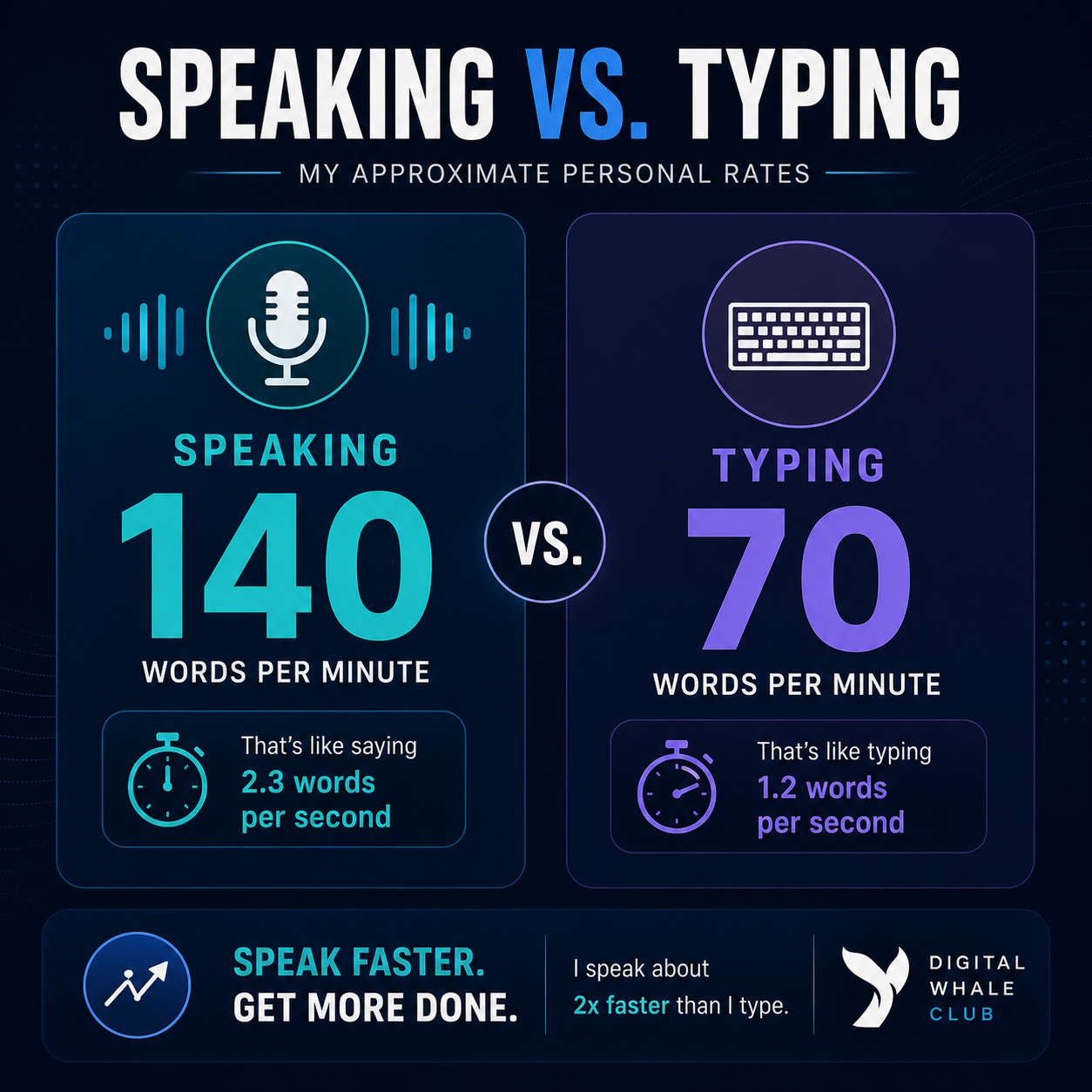
My personal estimate is that I can speak at roughly 140 words per minute but type at closer to 70. That means I can potentially capture twice as much raw material in the same amount of time.
The exact numbers are not really the point. The point is that speaking is clearly faster for me.
It also produces something that is harder to get from a generic AI prompt: my actual voice.
When I speak about a topic, my opinions come out naturally. So do my examples, frustrations, comparisons, word choices, and the small details that show I have real experience with what I am discussing.
The first version may not be perfectly cohesive. I might repeat myself, change direction halfway through a thought, or explain something in the wrong order.
That is fine.
I am not using speech-to-text because I want to publish an unedited transcript. I use it because speaking gives me better raw material faster.
A tool like Wispr Flow makes that process easier by converting speech into text as you talk. It can also adapt to vocabulary and track statistics such as dictated words and words per minute.
Once the ideas are captured, I can use other tools to organize them.

Wispr Flow is an AI-powered dictation tool that turns spoken thoughts into clear, polished writing across apps and websites. It automatically removes filler words, improves sentence structure, and formats your ideas as you speak, making it easier to write emails, documents, notes, and content faster without typing everything manually.
The Tools That Currently Make Me Faster
My content workflow currently relies most heavily on Wispr Flow, ChatGPT, and Claude.
I do not use all three tools for the same reason.
Wispr Flow helps me capture my thoughts
Wispr Flow is probably my most important tool for day-to-day content creation because it lets me speak instead of type.
I can explain an idea as it comes to me without stopping every few seconds to fix a sentence.
That matters because constantly switching between thinking and editing kills momentum. When I am speaking, I can stay focused on the argument I am trying to make.
ChatGPT helps me organize and edit
Right now, ChatGPT is usually my go-to tool for working with the raw material.
I use it to:
- Group related ideas
- Create a clearer structure
- Remove unnecessary repetition
- Improve transitions
- Identify missing explanations
- Turn spoken thoughts into readable written content
- Preserve my opinions and natural phrasing
The better the system understands my business and preferences, the less time I have to spend explaining the same context again.
ChatGPT Projects can keep chats, files, and instructions together, which makes it useful for recurring work where maintaining the same context, goals, and writing preferences matters.
I still review the result. I am not giving it an unedited transcript and blindly publishing whatever comes back.
The tool organizes the thinking. It does not replace my judgment.
Claude still has a place in my workflow
I move between ChatGPT and Claude depending on the task and which model I think is doing the better work at the time.
For article creation, I currently find myself using ChatGPT more often.
I still like Claude for building applications and experimenting with tools. Claude’s Artifacts feature is specifically designed to create reusable content, tools, visualizations, and interactive applications from a conversation.
That does not mean everyone needs three AI products.
The specific tool matters less than the role you give it.
Templates Stop Me From Rebuilding Every Article
Another reason I can produce content faster is that I do not start every article from zero.
I have built repeatable outlines and standard operating procedures based on hundreds of articles and pages.
Reviews are a good example.
A review usually needs to address predictable questions:
- What does the product do?
- Who is it for?
- Who should avoid it?
- Which features matter?
- What was my experience?
- Where does it fall short?
- Is it worth the price?
- What are the alternatives?
I should not have to rediscover that structure every time I review something.
A template reduces the number of decisions I have to make. It also makes the final content easier for readers to scan because the important information appears in a clear and familiar order.
That does not mean every post should be forced into the same outline.
A template is a starting point, not a prison.
The structure still needs to match the topic and search intent. A tutorial, opinion piece, comparison, and product review should not all look identical.
The purpose of a template is to remove repeated work while protecting the important parts of the article.
AI-Written Content Is Not the Real Problem
The easiest way to create a bad AI-written article is to open ChatGPT or Claude and type:
Write me a blog post about XYZ.
You have not given the tool any firsthand experience.
You have not explained what you believe.
You have not shared examples, mistakes, comparisons, or recommendations.
You have not given it a reason to produce anything beyond the most obvious information already available.
Then people are surprised when the article feels thin and generic.
AI-written content is not the problem. Shitty AI-written content is the problem. Google’s published guidance says that appropriate use of AI or automation is not automatically against its guidelines (source). The focus is on whether the content is helpful and created for people rather than primarily produced to manipulate rankings. That is the same standard I would apply even if AI were not involved.
There is a real person at the end of a search query. That person has a problem, question, or decision they are trying to work through. If they finish your article and still do not believe you understand the subject, the content has failed.
AI needs raw material worth editing.
Your experience, opinions, examples, screenshots, tests, and conclusions should be part of that material.
Speed, Originality, and Quality Can Coexist
You do not have to choose between writing quickly and sounding like yourself.
The mistake is asking AI to invent the entire article, then expecting the output to somehow reflect your voice.
Your voice has to be present in the input.
That is one of the reasons I like speech-to-text. It captures my phrasing and speech patterns before another system starts trying to clean everything up.
From there, AI can make the thoughts more cohesive without removing what made them mine.
Over time, you can also give your AI tools more context about:
- How you explain ideas
- Words and phrases you naturally use
- Opinions you hold
- Claims you do not want to make
- Formatting you prefer
- Types of examples you commonly include
- Language you want removed
Think of AI as an editor and organizer, not a substitute for having something worth saying.
Stop Editing While You Are Still Drafting
My advice to business owners who edit every sentence while drafting is simple:
Stop.
You are slowing yourself down.
Capture the full idea before you start correcting every word. You will make better editing decisions once you can see the whole argument. A paragraph that seems essential while you are drafting may become unnecessary once the rest of the article exists. A sentence you spent ten minutes polishing may be deleted entirely. Finish the thought first.
Then edit the article instead of editing every keystroke.
There is a point where polishing stops improving the content and starts becoming procrastination.
Business owners have limited time. You are already managing products, customers, employees, operations, marketing, and everything else the business requires.
You do not need to treat every blog post like it is the only piece of content you will ever publish.
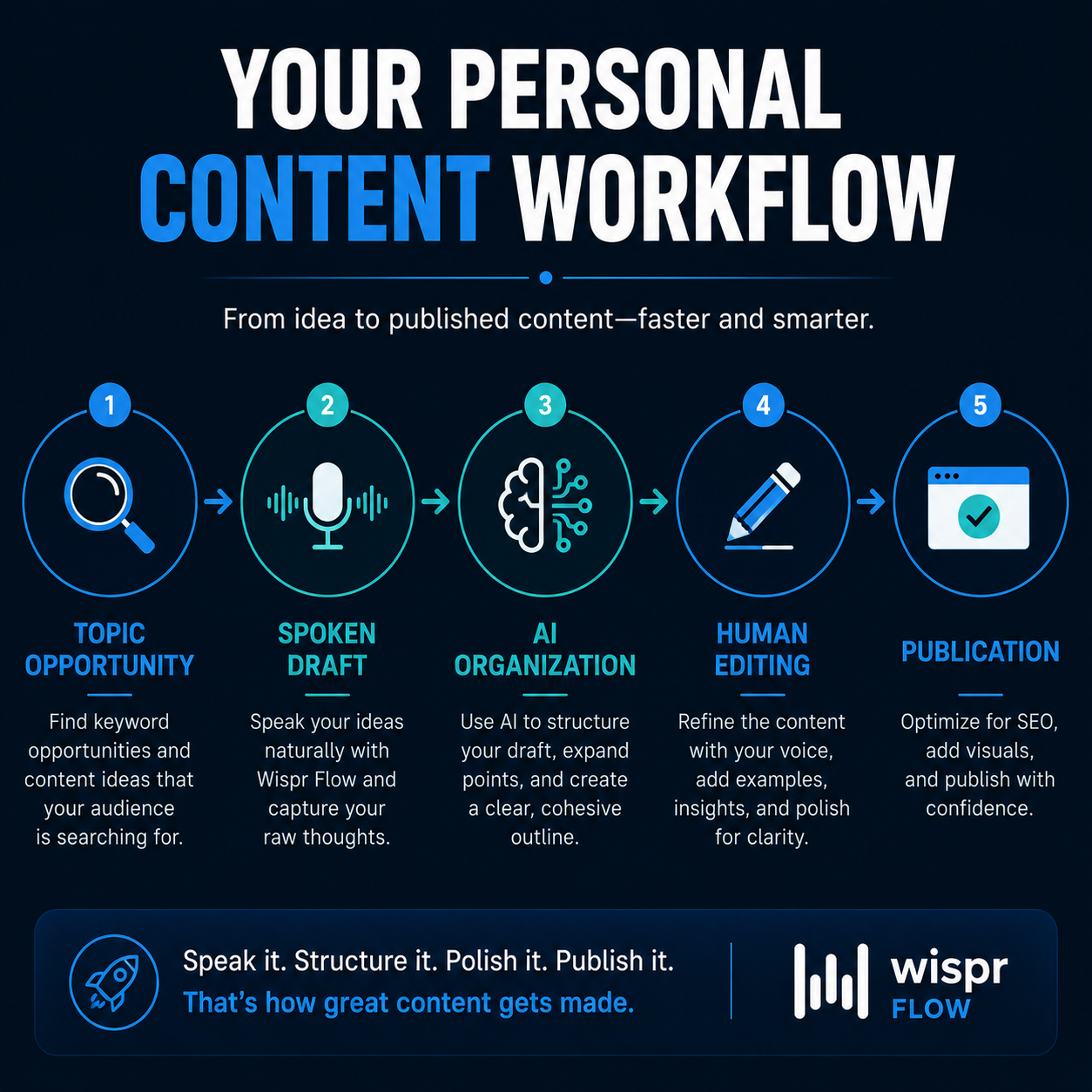
What My Faster Content Process Looks Like
I do not think every person needs to follow one rigid step-by-step workflow.
This is simply what currently works for me:
- I find a topic or opportunity using tools such as Ahrefs or ChatGPT.
- I speak freely about the subject and capture my firsthand thoughts.
- I use a repeatable outline when the article type calls for one.
- I give the raw material to AI and ask it to organize the ideas.
- I review the draft for accuracy, usefulness, voice, and missing context.
- I edit it into a publishable article and move on.
The important part is not copying every tool I use.
The important part is separating original thinking from organization and editing.
That is what removes the bottleneck.
What I Would Not Sacrifice for Speed
There are still parts of content creation that should not be skipped.
I would not sacrifice:
- Accuracy
- Firsthand experience
- Clear explanations
- Original opinions
- Reader satisfaction
- Human review before publication
Writing faster should not mean publishing anything the AI gives you.
Google uses many systems and signals to identify relevant and useful results, and its current guidance continues to emphasize unique, helpful content that satisfies the people visiting from Search.
You do not need to guess at one secret metric.
Create content that answers the question better, includes something original, and leaves the reader feeling like their time was well spent.
Build a Faster System, Not Lower Standards
The goal is not to get better at typing.
The goal is to remove unnecessary work from the process of turning your knowledge into publishable content.
For me, that means speaking instead of typing, using templates instead of rebuilding every structure, and giving AI enough context to organize my real thoughts.
I am not interested in producing content faster just so I can say I published more.
I want to remove the parts of writing that slow me down without making the final article any less useful.
Speed matters. Originality matters. Quality matters.
You can have all three, but only when your tools are built around your ideas instead of being asked to replace them.
Frequently Asked Questions
Does writing blog posts faster reduce quality?
Not automatically. Quality drops when you skip research, accuracy checks, useful examples, or editing. A more efficient system can remove unnecessary work while preserving the parts readers care about.
Is it acceptable to use AI to write blog posts?
Yes, provided AI is used to create useful content rather than manipulate search rankings. Google’s guidance does not ban AI-generated content simply because AI was involved.
Can I use speech-to-text for long-form content?
Yes. Speech-to-text can be especially useful for capturing opinions, explanations, and firsthand experiences. The transcript will usually need to be organized and edited before publication.
How do I keep my voice when using ChatGPT?
Give ChatGPT your own raw material. Spoken transcripts, previous articles, opinions, examples, and clear editing instructions provide a much stronger voice reference than a generic prompt.
Should I outline a blog post before writing it?
An outline can help, but you do not always need to create one manually before capturing your ideas. You can speak through the topic first and organize the material afterward. Repeatable templates are particularly useful for article types you publish regularly.
How long should it take to write a blog post?
There is no useful universal answer. The time depends on the topic, research requirements, firsthand testing, article length, and editing needed. Focus on reducing avoidable work rather than trying to meet an arbitrary time limit.