

When people compare internal links and backlinks, the safest answer is usually, “You need both.”
That’s true, but it avoids the real question.
Which one actually matters more for rankings and traffic?
Based on what I’ve seen across two websites I’ve operated for the past couple of years, backlinks have made the bigger difference. Internal links improved the organization of the sites, connected related content, and made it easier for readers and search engines to move between pages.
The real movement came when I started earning backlinks.
One of my sites already had strong internal link coverage. Its posts communicated well with each other, and very few important pages were left disconnected. What it lacked was outside authority. After I doubled down on building a legitimate backlink profile, the site’s traffic grew by roughly 10 times over the following year.
That doesn’t mean internal links are optional. It means internal links and backlinks perform different jobs, and backlinks usually have the greater ability to move the needle.
The Quick Answer
Backlinks generally matter more than internal links when your goal is ranking for competitive keywords and producing meaningful organic traffic growth.
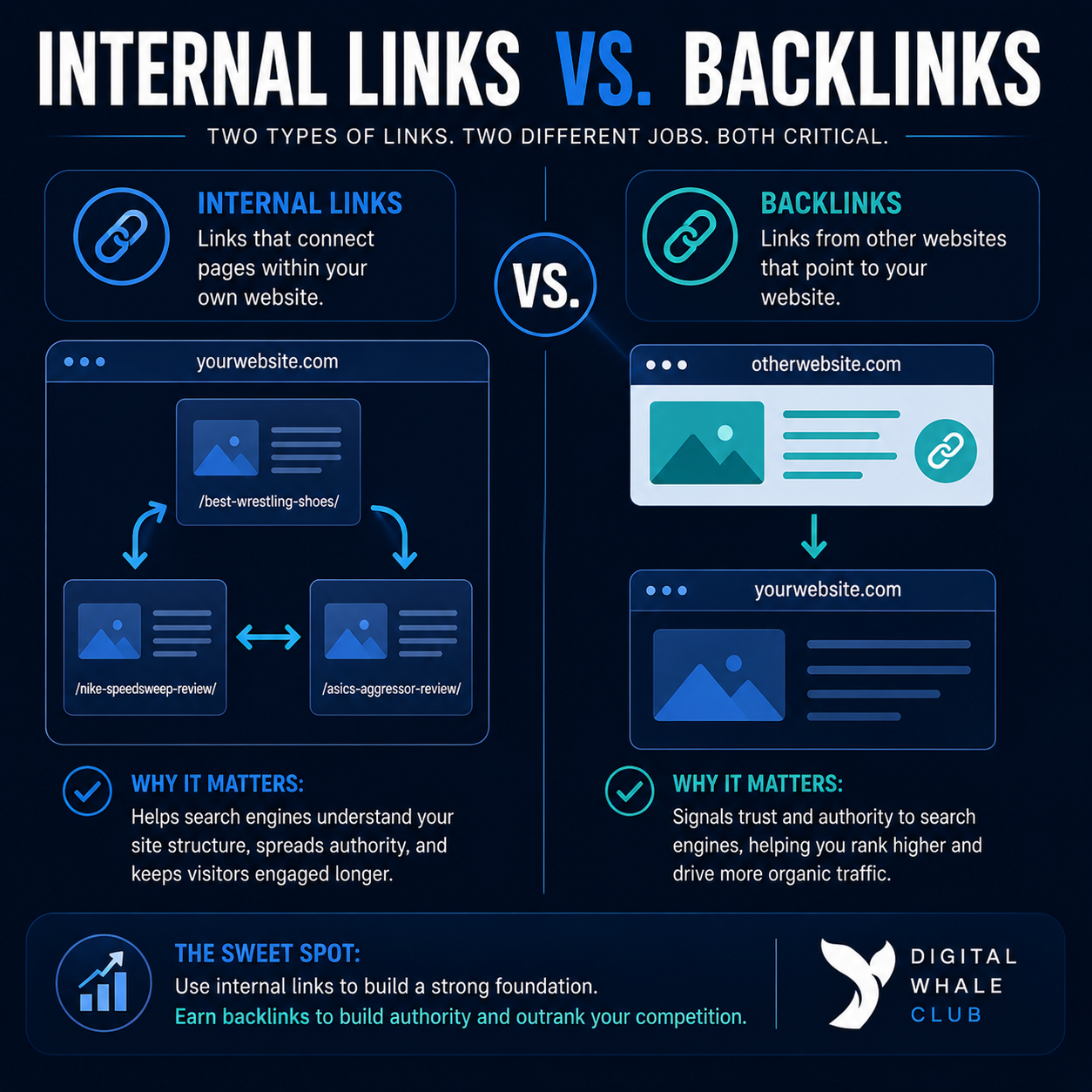
Internal links help Google find pages, understand the relationships between them, and navigate your website. They also help distribute the authority your site already has.
Backlinks introduce trust and authority from outside your website.
Google uses links to find new pages and as a signal when determining relevance. PageRank and other link-analysis systems also remain part of Google’s core ranking systems, although Google uses many other signals as well (source).
My recommendation is to work on both at the same time. Build a sensible internal structure first, then dedicate more of your ongoing time and resources to earning legitimate backlinks.
Internal Links vs Backlinks: What Is the Difference?
| Factor | Internal links | Backlinks |
|---|---|---|
| Link source | Another page on your website | A different website |
| Main purpose | Navigation, context, discovery, and authority distribution | External trust, discovery, relevance, and authority |
| Your control | High | Limited |
| Difficulty | Usually easier | Usually harder |
| Main risk | Irrelevant links or overoptimized anchor text | Paid, automated, or manipulative link building |
| Impact I’ve observed | Better structure and optimization | Greater ranking and traffic movement |
What Is an Internal Link?
An internal link connects one page on your website to another page on the same domain.
For example, a guide about broken-link building might internally link to your broader guide about earning backlinks. A software review might link to a best-of list that compares the software with its competitors.
You decide where the link appears, which page it points to, and what anchor text it uses.
What Is a Backlink?
A backlink is a link from another website to yours.
Unlike an internal link, you cannot simply give yourself a credible backlink. Another publisher, journalist, business, blogger, or website owner has to choose to reference your page.
That outside decision is what gives backlinks their value.
Why Backlinks Usually Move the Needle More
Backlinks Work Like External Trust Points
I think of backlinks as trust points.
Imagine SEO as a game where websites collect trust from other trusted websites. The more legitimate trust points a site earns, the stronger its chances of competing in search results.
Internal links cannot provide the same type of validation because they come from your own website. You control them completely. You can create 100 internal links to a page tomorrow, but that does not mean 100 independent sources have decided the page is credible.
A backlink says something different:
Someone outside this website believed this page was useful enough to reference.
Google does not rank pages using backlinks alone. Its ranking systems consider many factors and signals. Still, Google openly states that it uses links to understand what pages are about, determine which pages might be useful, and find new URLs to crawl (source).
My Traffic Grew After I Focused on Backlinks
The clearest evidence for me came from one of my own websites.
The site already had strong internal link coverage. Related posts connected naturally, and the content was organized well. Internal linking made the site cleaner and easier to navigate, but it did not create the search movement I was looking for.
Once I started putting more time into the backlink profile, I noticed a massive difference. Over roughly a year, the site’s traffic grew by around 10 times.
This was not a controlled scientific experiment, so I would not claim every bit of that growth came from backlinks. Content quality, site age, technical improvements, and other factors also contribute to SEO.
Still, the timing and ranking movement were clear enough for me to reach a practical conclusion: the site already had the internal structure, but backlinks provided the missing juice.
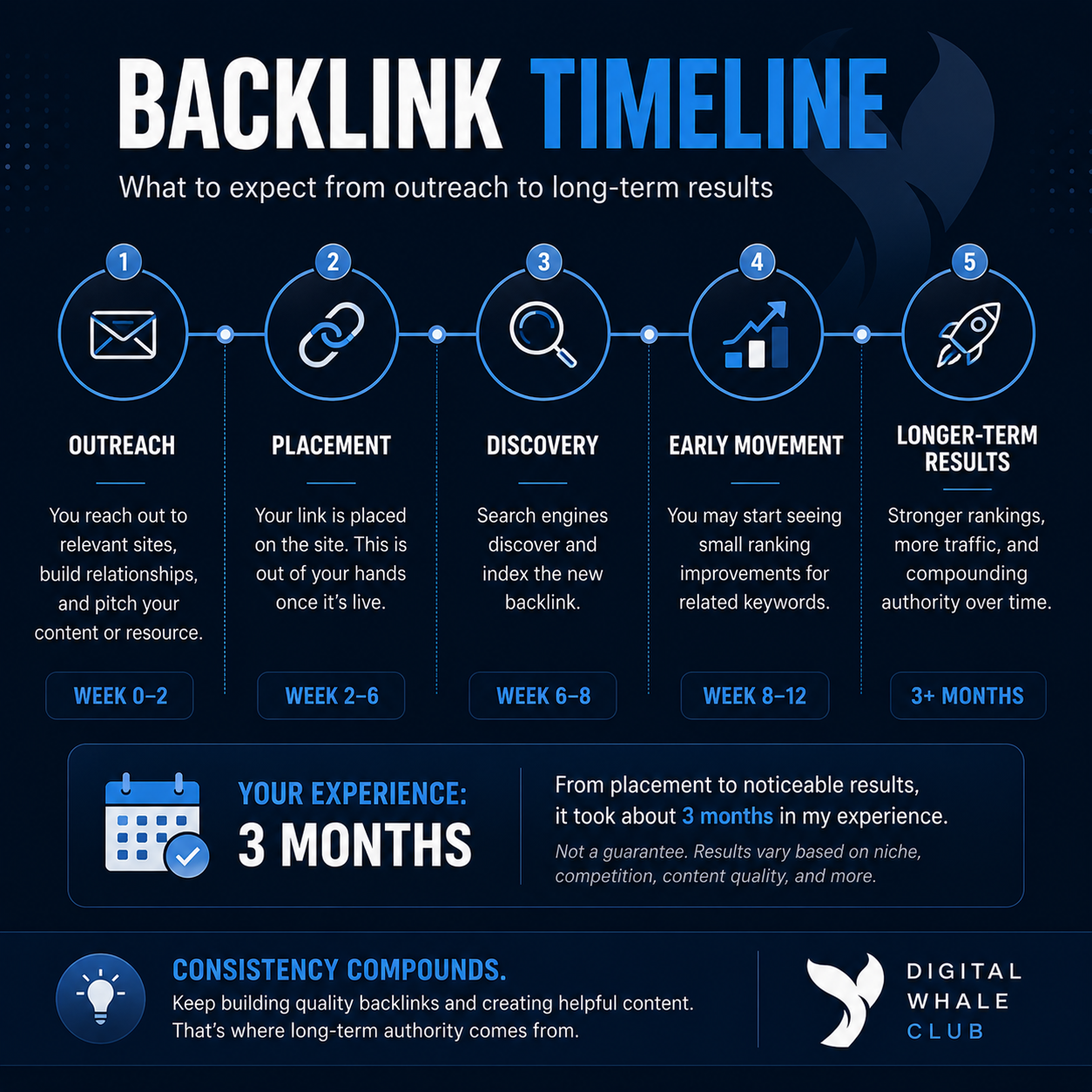
In my experience, a new backlink can take around three months before I begin to see the early stages of its impact. That is not a guaranteed SEO timeline. Some links may appear to help sooner, some later, and some may produce no measurable movement at all.

Competitive Niches Make Backlinks More Important
It is possible to rank a page without building direct backlinks to it, particularly when the query has little competition or the domain already has substantial authority.
In a genuinely competitive niche, though, ranking without backlinks is extremely difficult.
You may be competing against established websites with years of history, strong content libraries, recognizable brands, and thousands of referring domains. A well-written article with perfect internal linking does not automatically overcome that disadvantage.
Good content gives people a reason to link to you. It does not guarantee that they will.
What Internal Links Actually Do Well
Saying backlinks matter more does not mean internal links are unimportant.
Internal links are part of the infrastructure that allows a site to use its authority effectively.
They Help Google Find and Understand Pages
Google recommends linking every page you care about from at least one other page on your site. It also recommends using descriptive anchor text so readers and Google can understand the destination (source).
A page with no internal links pointing to it is commonly called an orphan page. Even when the page is included in a sitemap, it is poorly integrated into the rest of the website.
Google says that when a site is comprehensively linked internally, its crawlers can find important pages by following links from the homepage and other pages (source).
They Distribute Existing Authority
A page with traffic, backlinks, and a strong history can link to other relevant pages that deserve more attention.
I think of this as authority bleeding into connected content.
For example, imagine you have a detailed guide that has earned dozens of backlinks. That guide can internally link to a newer article, product page, service page, or review that covers the next logical step.
The internal link helps pass context and value into that page.
The distinction is important:
Internal links distribute authority. Backlinks bring outside authority into the site.
They Improve User Experience
Internal links are not only for search engines.
A visitor who finds one useful article may have another obvious question. A relevant internal link lets that person continue learning without returning to Google.
That can help readers discover:
- Related tutorials
- Supporting explanations
- Product reviews
- Service pages
- Comparisons
- Revenue-generating content
This is where internal linking becomes the sweetener in the cake. It keeps people consuming the content because each page naturally leads to another useful piece.
Which Should You Work on First?
The answer depends on what is currently wrong with the website.
Start With Internal Links When the Site Is Disorganized
Fix the internal structure first when:
- Important pages are orphaned
- Related posts are not connected
- Navigation is confusing
- Old content never links to newer content
- Commercial pages are buried
- Anchor text is vague or misleading
You do not need a perfect internal-linking system before beginning outreach. You only need a foundation that allows important pages to be found and understood.
Prioritize Backlinks When the Foundation Is Already Sound
A website with good content, clear navigation, and strong internal coverage may not need another month of internal-link tweaking.
It may need external credibility.
This was the situation I faced. Continuing to rearrange internal links was not going to create the same opportunity as earning links from relevant third-party websites.
Once the basic structure is sound, I would allocate more ongoing effort to backlinks.
Use Both for Commercial Pages
Reviews, best-of lists, product pages, and service pages often have the clearest connection to revenue.
These pages should receive relevant internal links from supporting content. Direct backlinks can also be valuable when you can earn them naturally.
Homepage backlinks matter too. They can strengthen the broader domain, while internal links from the homepage and other authoritative pages help guide that value toward priority content.
Not every page needs its own backlink campaign. Prioritize the pages most capable of attracting links, ranking for valuable searches, or producing revenue.
The Best Strategy Is to Do Both at the Same Time
Internal linking should be part of your publishing process.
Whenever you publish a new article, ask:
- Which older pages should link to this?
- Which existing pages would help someone reading this article?
- Is there a related commercial page that deserves a contextual link?
- Can a reader reach this page without using the sitemap?
Tools such as Link Whisper can speed up the process by identifying internal-link opportunities and orphaned content. I still recommend reviewing every suggestion manually. Relevance matters more than the number of links.
At the same time, continue earning backlinks.
I use Wispr Flow to dictate outreach emails and journalist-query responses instead of typing each one manually. That does not automate the creation of backlinks. It speeds up the human communication required to pursue them.
That difference matters.
Backlink Tactics Worth the Effort
Manual Outreach
Manual outreach is not easy, and you will probably need to send far more pitches than you expect before earning meaningful links.
The goal is not to send the highest number of emails. It is to find a legitimate reason another website would benefit from linking to your resource.
Personalization, relevance, and timing make the difference.
Broken-Link Building
Broken-link building has worked well for me.
The process is straightforward:
- Find a page linking to a dead, outdated, or weak resource.
- Create or identify a fresher and more useful replacement.
- Contact the site owner.
- Explain where the old link appears.
- Suggest your page as a possible replacement.
You are helping the publisher fix a reader-experience problem while giving your content a legitimate chance to earn a link.
Journalist and Expert-Source Queries
Platforms such as HARO, Featured, and Qwoted connect publishers with people who can contribute experience or expert commentary.
These opportunities still require effort. You have to respond quickly, answer the actual question, and provide something worth quoting.
Wispr Flow helps me answer more of these queries because speaking a useful response is faster than typing every word.
Linkable Assets
Outreach is much easier when the page deserves attention.
Useful linkable assets can include:
- Original testing
- Industry data
- Free tools
- Calculators
- Templates
- Detailed comparisons
- Custom graphics
- Research-backed guides
- Firsthand case studies
You cannot force people to care about an average article by sending more emails.
Backlink Tactics I Would Avoid
I do not buy backlinks for any of my sites.
I also would not use an AI system or automated service that promises to manufacture a backlink profile at scale. That looks less like a shortcut and more like a ticking time bomb.
Google’s spam policies identify buying or selling links for ranking purposes, excessive exchanges, automated link-creation programs, low-quality directories, and low-value content created to manipulate linking signals as examples of link spam (source).
The same principle applies to AI content.
Using AI is not automatically against Google’s guidelines. Google says generative AI can help with research and structure. The problem is using it to generate large numbers of pages without adding value, which may violate the scaled-content-abuse policy (source).
AI can speed up good SEO work. It should not be used to disguise bad SEO work.
Good SEO is good SEO at the end of the day.
Common Internal-Linking Mistakes
Leaving Pages Orphaned
Every important, indexable page should be reachable through a normal internal link.
Treating Internal Linking as a One-Time Project
Your internal structure should improve as the content library grows. New content creates new opportunities to update older posts.
Using Generic Anchor Text
Anchor text such as “click here” gives readers little information. Use concise language that describes what they will find.
Adding Every Link a Tool Suggests
Software can identify possible relationships, but not every suggestion improves the article. Irrelevant links create clutter and weaken the reading experience.
Ignoring High-Traffic Content
Older pages with backlinks and traffic are often some of the best places to add links to newer related resources.
Managing a Large Site Entirely by Hand
Manual review remains important, but manually finding every opportunity becomes inefficient as a website grows. Use software to surface possibilities, then use your judgment to decide which links belong.

Link Whisper is a WordPress internal linking plugin that helps website owners find relevant linking opportunities, add contextual internal links faster, and identify orphaned content. It simplifies site structure and internal link management without requiring you to manually search through every post.
Final Verdict: Backlinks Matter More
Internal links and backlinks are both ingredients in the overall SEO cake, but they do not provide equal value.
Internal links organize the site, connect related information, improve crawlability, distribute existing authority, and guide readers toward the next useful page.
Backlinks provide external trust points.
Across the websites I operate, internal linking created a stronger foundation. Backlinks produced the clearest ranking movement and traffic growth.
Build both at the same time, but once your basic internal structure is sound, put more of your energy into earning legitimate backlinks.
Internal links help hold the cake together and guide people toward the next slice. Backlinks show that people outside your kitchen think the cake is worth recommending.
Frequently Asked Questions
Can internal links replace backlinks?
No. Internal links can distribute authority and make pages easier to find, but they cannot provide the same external validation as a backlink from another credible website.
Can a page rank without backlinks?
Yes, particularly for low-competition searches or on an established domain. However, ranking without backlinks becomes much harder as competition increases.
Do homepage backlinks help other pages rank?
Homepage backlinks can support the authority of the broader site. Internal links then help connect the homepage and other strong pages to the content you want readers and search engines to discover.
How long does a backlink take to affect rankings?
There is no universal timeline. In my experience, I often begin noticing early movement at around three months, but some backlinks may take longer or produce no measurable impact.
How many internal links should a blog post have?
There is no ideal number. Add links when they help the reader understand the topic, answer a related question, or reach an important relevant page. Do not add links solely to hit a target.
Are AI backlink-building tools safe?
AI can help research opportunities, draft outreach, or speed up communication. I would avoid tools that automatically create large numbers of links or attempt to manipulate rankings. Google specifically lists automated programs or services that create links as link spam.