

The first dollar I ever made online was actually $1.22. I’m pretty sure it came from an Amazon affiliate sale. It took around four months of building my first content site before that commission showed up. It wasn’t life-changing money. It didn’t even cover lunch. But it proved that somebody could find my website, read what I had to say, click a link, and buy something.
It took about eight months to make my first $100 in a single month. By the end of the first year, the site was earning somewhere between $250 and $500 per month. Another eight months passed before it reached approximately $1,000 per month.
For roughly 16 months, revenue bounced between $800 and $1,000 per month. Only recently, almost four years into the project, did it jump to around $2,500 per month.
That timeline probably isn’t what most people want to hear.
Content sites are usually presented as passive-income machines where you publish articles, wait a few months, and collect checks. That hasn’t been my experience. Building a profitable content site has been a long process of learning new skills, making expensive mistakes, sitting through plateaus, and slowly understanding what actually moves the business forward.
The good news is that content sites are still worth building in 2026.
The old playbook just isn’t enough anymore.
A content site today needs to be treated like a real business. It needs a clear topic or niche, monetization strategy, useful content, backlinks, distribution channels, and a recognizable person or brand behind it.
You aren’t just starting a website. You’ve got to focus on building an asset that should eventually generate more money each month than it costs to operate.
Why Even Build a Content Site in the First Place
A website gives you one centralized place where people can learn what you do, how you can help them, and why they should trust you. Most people who want to make money online immediately turn to Instagram or TikTok. Those platforms are great for building an audience, but they should not be the only places where you invest your time.
You are competing with an endless stream of creators, trends, and distractions, and the content you post can disappear almost as quickly as you publish it.
A strong website works differently.
One useful blog post can rank on Google, attract readers, and make money for years.
This applies to almost any niche, including real estate, parenting, pets, makeup, running, or something completely different. Over time, that content can grow into more than a blog. You can build a recognizable brand, launch products or services for your audience, or even create an asset that someone may want to buy.
Social media can help people discover you, but your website gives everything you create a permanent home.
What is a Content Site?
A content site, sometimes called an authority site, is a website built around a specific topic or niche. Instead of relying on one product or service, it publishes useful articles that answer questions, solve problems, and help readers make decisions.
Over time, those articles can attract traffic from Google and build trust with a specific audience. The more helpful and focused the site becomes, the more authority it can develop in that niche, which can create opportunities to earn money through ads, affiliate links, services, digital products, or even selling the site itself.
What Makes a Content Site Profitable?
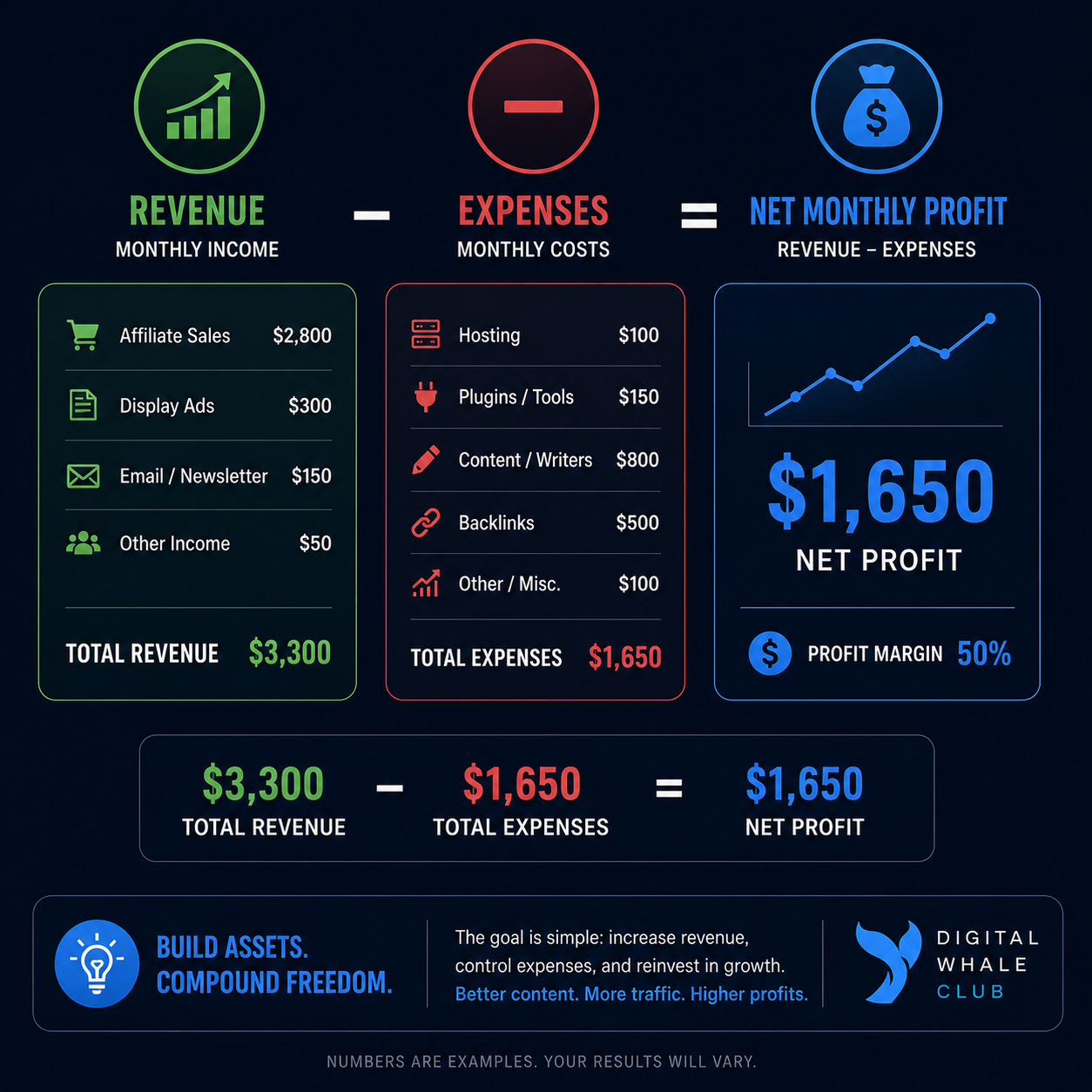
The simplest definition of profitability is:
Monthly revenue minus monthly expenses equals monthly net profit.
If your site earns $2,500 in a month and costs $400 to operate, there is roughly $2,100 left before accounting for variable expenses such as employees, contractors, product purchases, or additional link building.
That distinction matters because revenue isn’t the same thing as profit.
People love sharing affiliate dashboards, ad revenue screenshots, and big monthly numbers. Those screenshots rarely show what was spent to produce the result.
A content site will need to pay for the following:
- A domain name
- Website hosting
- SEO and research software
- Writers or editors
- Original products for testing
- Email marketing software
- Link building
- Design and development
- Video equipment or editing
- Contractors or employees
My established site currently has around $400 per month in bare-minimum fixed operating costs. That doesn’t include every employee expense, backlink, or optional investment I may make during a given month.
Digital Whale Club costs me less than $20 per month directly because some of the software and infrastructure are already being paid for by the established site. That’s one of the advantages of having an existing profitable asset. It can give the next project room to breathe.
Anyone telling you that you can build a serious website, business, or long-term asset without investing money or time isn’t giving you the whole story. It costs something to build things. It should cost something.
Your initial investment may be mostly sweat equity. It may be software, hosting, content, links, equipment, or contractors. Most likely, it will be some combination of all of them.
This guide focuses on monthly cash flow because that’s the clearest way to determine whether the site is supporting itself. Recovering every historical expense, calculating a future sale price, and valuing the asset are different conversations.
First, get the thing producing more money than it consumes.
Are Content Sites Still Worth Building in 2026?
Yes, but I wouldn’t build one the same way I would have built it several years ago.
A lot of independent websites lost traffic during the search turbulence of 2024 and 2025. Some businesses disappeared entirely. Others cut their publishing budgets, stopped updating their sites, or moved their attention toward social media.
That sounds like a reason to avoid the industry.
In some areas, I think it created the opposite opportunity.
There are keywords in my established site’s niche where I’ve consistently remained one of the few independent operators ranking near the top. The search demand didn’t disappear just because some competing sites lost visibility.
People still need help:
- Understanding complicated subjects
- Comparing products
- Making purchasing decisions
- Solving technical problems
- Avoiding expensive mistakes
- Finding someone who has actually used what they’re considering
There are still thousands of problems that useful websites can solve.
The industry also isn’t as sexy as people make it sound. You spend a lot of time writing, editing, researching, fixing things, answering emails, creating links, and checking performance. A lot of people would rather become influencers. That’s fine. It also means there may be less committed competition in spaces where businesses need real depth, searchable resources, and long-term authority.
Google’s current guidance is straightforward. It recommends creating helpful, reliable, people-first content with original information, substantial analysis, firsthand expertise, and a clear purpose. It also warns against producing large amounts of automated content without adding meaningful value.
AI Made Content Production Easier, Not Authority Automatic
AI gives an individual operator the ability to research, organize, edit, and produce content faster than before. I use it throughout my own workflow. I speak many of my ideas using voice-to-text software. Then I use purpose-built GPTs and editorial systems to turn that spoken material into cohesive articles without stripping out the way I naturally explain things.
That saves me a lot of time. It does not replace the thinking.
AI can organize a story about the first $1.22 I earned, but it didn’t earn that money. It didn’t sit through the 16-month revenue plateau. It didn’t hire a writer too early, neglect backlinks, or figure out which affiliate offers converted.
That information has to come from me.
AI cannot honestly manufacture:
- Firsthand results
- Product experience
- Original screenshots
- Failed experiments
- Customer conversations
- Personal judgment
- Credible recommendations
- The reason you changed your mind
Google’s 2026 guidance for its AI search features makes a similar distinction. It recommends unique, non-commodity content with firsthand viewpoints, useful images, video, and information that couldn’t simply be reproduced by another generative AI system.
That’s the opportunity. Use AI to make yourself faster. Don’t use it to pretend you know something you don’t.
Choose a Niche You Can Stay Interested In
Building websites gets monotonous.
There will be days when you don’t want to write another article, update another comparison table, record another video, or answer another outreach email.
You might as well be bored talking about something you’re actually interested in.
For a first content site, I would look for the overlap between:
- Something you naturally care about
- Something you already understand or want to master
- Problems people actively need help solving
- Products or services people already spend money on
Digital Whale Club covers personal finance, cryptocurrencies, collectibles, online business, SEO, and related topics. Those subjects fit me because I can talk about investing, business strategy, websites, and making money online all day.
I already have those conversations naturally.
That doesn’t mean passion is the only consideration. A topic can be fascinating and still have a weak business model.
Before committing to a niche, look at:
- The products people buy
- The services they compare
- The questions they search for
- The companies running affiliate programs
- The average commission available
- The level of competition
- The number of useful subtopics
- Your ability to add firsthand evidence
- The likelihood that you can stay involved for several years
I also wouldn’t choose a niche based only on search volume.
A giant keyword can look attractive until you realize the intent is weak, the competition is brutal, and there is no obvious way to monetize the traffic.
A smaller topic with strong purchase intent may be far more valuable.
Experienced operators can eventually make pure money plays. By the time you’ve built three or four sites, you may have the systems and discipline to enter an industry that doesn’t interest you personally.
Your first site is different. You aren’t only building a business. You’re learning SEO, content production, WordPress, affiliate marketing, analytics, link building, video, and audience development at the same time. Interest helps you survive the learning curve.
Plan Your Monetization Before You Publish
I don’t believe there is anything wrong with thinking about monetization from day one.
Helping readers and making money aren’t mutually exclusive.
A good affiliate content site does both:
- It answers a real question.
- It helps the reader evaluate a decision.
- It recommends an appropriate product or service.
- It earns money when that recommendation results in a sale.
The problem starts when the recommendation exists only because the commission does.
Before publishing, map the types of search intent available in the niche:
- Informational
- Problem-solving
- Product discovery
- Comparisons
- Reviews
- Transactional searches
- Post-purchase support
The most valuable page isn’t always the page with the most traffic.
My established site is largely a search-intent business. People find it when they are researching products they may use regularly. The website becomes a dedicated resource that helps them make a buying decision.
That traffic can be worth significantly more than broad entertainment traffic.
Evaluate the Economics of an Affiliate Offer
As a general starting point, I like affiliate offers that pay somewhere between $20 and $50 per conversion.
That isn’t a fixed rule.
You also have to consider:
- Search volume
- Commercial intent
- Competition
- Conversion rate
- Brand recognition
- Cookie duration
- Recurring versus one-time payouts
- Refunds or commission reversals
- The quality of the product
- Whether you can recommend it credibly
A $5 commission tied to a brand with fewer than 1,000 monthly searches may not be worth a major investment.
A $5 commission tied to a recognizable brand with hundreds of thousands of searches can be a completely different business.
Low commissions can work when there is enough volume and strong buying intent. High commissions can fail when nobody is searching, nobody trusts the offer, or the product doesn’t convert.
The goal is to find the combination of demand, intent, commission, and competition that makes sense.
| Offer type | Search demand | Commission | Typical opportunity |
|---|---|---|---|
| Low demand, low commission | Low | Low | Usually weak |
| Low demand, high commission | Low | High | Situational |
| High demand, low commission | High | Low | Volume play |
| Moderate demand, moderate commission | Moderate | $20 to $50 | Strong starting target |
| High intent, recurring commission | Varies | Recurring | Potentially valuable |
Affiliate marketers also need to disclose their financial relationship clearly and conspicuously. The FTC specifically advises placing the disclosure close to the recommendation so readers understand that purchases may generate a commission.
Don’t hide the business model. Good readers already understand that websites need to make money.
Build Topical Authority One Cluster at a Time
Digital Whale Club covers several broad areas, but I’m not trying to establish authority in all of them at once.
Right now, I’m focusing on a narrower cluster around:
- Online business
- SEO
- Making money online
- Building content sites
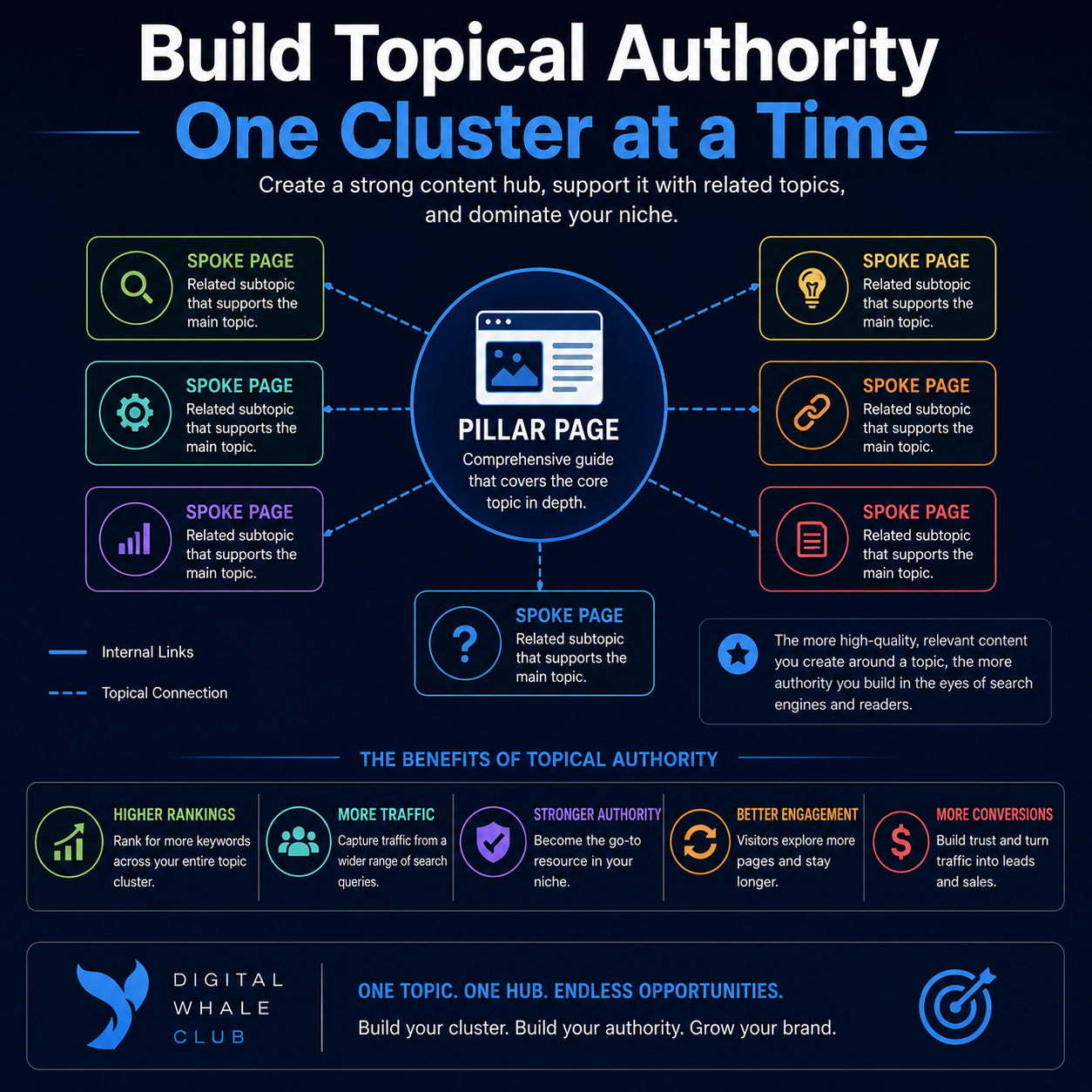
Once that cluster becomes deep enough, I can branch into related areas. This is the hub-and-spoke method. The hub is a broad, comprehensive resource about the main topic. This article is an example. The spokes are focused articles that explore individual parts of the process.
Possible spokes connected to this guide include:
- How to choose a profitable website niche
- How to evaluate an affiliate program
- How to build backlinks to a new site
- How to plan a topical content cluster
- How to turn blog posts into YouTube videos
- How to track affiliate conversions
- How to use AI without publishing generic content
Each spoke supports the hub. The hub helps readers discover the spokes. Together, they create a useful body of information around a clear subject. That is different from publishing random articles. Fifty disconnected posts aren’t automatically more authoritative than fifteen closely related articles that answer the questions a reader actually has.
Content volume isn’t topical authority.
Topical authority comes from covering a subject with enough depth, organization, original experience, and internal connections that both readers and search engines can understand what the site is good at.
Google advises site owners to maintain a clear purpose or focus, demonstrate firsthand knowledge, and create content that leaves readers feeling they have learned enough to accomplish their goal.
Start narrower than the brand you eventually want to build. You can expand after you’ve earned the right to.

Link Whisper is a WordPress internal linking plugin that helps website owners find relevant linking opportunities, add contextual internal links faster, and identify orphaned content. It simplifies site structure and internal link management without requiring you to manually search through every post.
Build the Simplest Website That Can Support the Business
You don’t need an expensive custom website to begin.
You need a site that:
- Loads properly
- Can be crawled
- Makes publishing manageable
- Gives you control over your content
- Supports analytics and affiliate tracking
- Can grow with the business
I use WordPress, but it isn’t the only CMS available.
WordPress itself is open-source software, but a normal self-hosted WordPress site still needs a hosting provider or server environment.
Don’t spend six months obsessing over a logo, custom theme, or perfect homepage while the website has no useful content.
Get the foundation right, then publish.
Install Measurement From Day One
Connect Google Search Console as early as possible. Search Console shows the queries bringing users to the site, along with impressions, clicks, average positions, indexing information, and technical issues Google detects.
At minimum, track:
- Indexed pages
- Search impressions
- Organic clicks
- Average search positions
- Affiliate link clicks
- Conversion rates
- Revenue by page
- Email signups
- YouTube referrals
- Returning visitors
Your first objective isn’t to make thousands of dollars.
Your first objective is to prove that the system works.
Can Google crawl the site? Are pages being indexed? Are impressions growing? Are people clicking affiliate links? Is any content moving closer to page one?
Those signals tell you where to focus next.
Create Content That Sounds Like a Real Person
A blank document slows a lot of people down. I’ve found that speaking is often easier than trying to type a perfect article from the first sentence.
My current process looks something like this:
- I choose a topic and define the search intent.
- I speak through what I know using voice-to-text.
- I include my experiences, examples, opinions, and mistakes.
- I use a custom GPT to organize that spoken material.
- I edit the result so it still sounds like me.
- I add evidence, screenshots, sources, internal links, and video.
- I publish it and improve it based on what readers and performance data show me.
The final piece should feel like the reader is talking to the person behind the site. That matters more now because generic information is everywhere.
You don’t need to sound like a corporate writing department. You need to be clear, useful, honest, and consistent.
My voice-to-text process also makes it easier to turn written content into video. I’m not starting from scratch twice. I’ve already worked through the argument and the examples.
This creates a natural internal link to my article about why I don’t write anymore and how I use voice-to-text to create content.
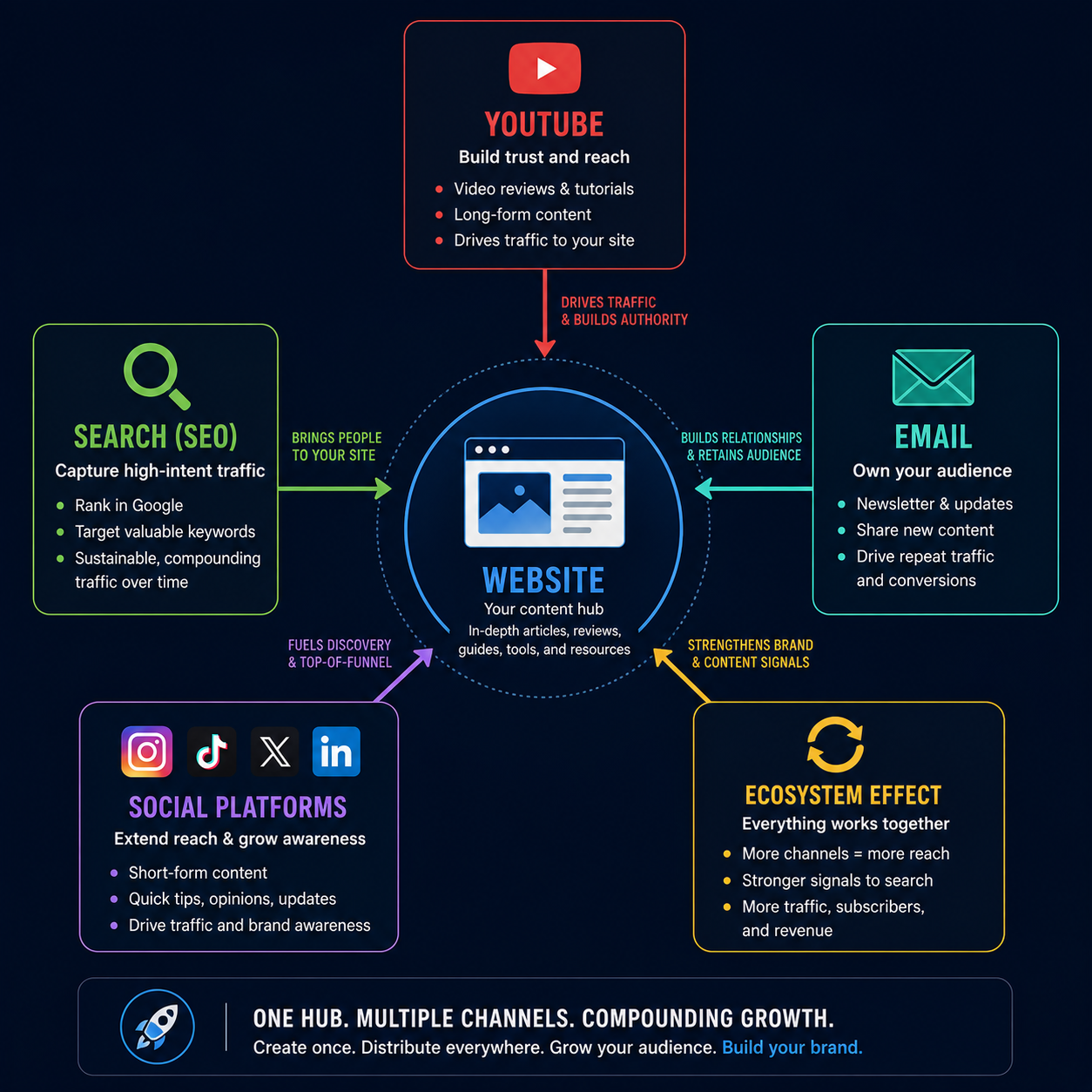
Build the Website and YouTube Channel Together
The biggest thing I wish I had done differently with my first site is start YouTube from day one.
The website and YouTube are the first two channels I would build together in 2026.
The website gives you:
- An owned content library
- Search visibility
- Affiliate pages
- Email capture
- Detailed resources
- A central home for the brand
YouTube gives you:
- Another search engine
- A visible person behind the information
- Subscribers who can return
- Video demonstrations
- A way to build trust before a purchase
- Content that can be embedded into articles
YouTube says its search system primarily evaluates relevance, engagement, and quality. Relevance includes how well the title, description, tags, and video itself match the query. Quality includes signals that indicate expertise, authority, and trustworthiness on a topic.
That doesn’t mean YouTube gives a website special treatment because Google owns both platforms. YouTube explicitly says it doesn’t favor Google-owned content in organic results.
The synergy comes from the content workflow and the audience, not preferential rankings.
You can:
- Publish the article.
- Turn the article into a long-form video.
- Embed the video in the article.
- Direct viewers to the deeper written resource.
- Ask both audiences to join your email list.
- Cut useful sections into short-form clips when you have the bandwidth.
I wouldn’t tell every beginner to launch five social platforms immediately.
Start with the website and YouTube. Add basic email capture from the beginning. Repurpose into short-form content when the core process is functioning.
Trying to be everywhere can become an excuse for doing nothing well.
Capture Email From the Beginning
Your email list is one of the few audience channels you have meaningful control over.
Search engines can change. Social platforms can reduce reach. Accounts can be suspended. Algorithms can shift.
An email subscriber has voluntarily asked to hear from you again.
That doesn’t mean you need a complicated 30-email automation during your first month.
Start with a relevant reason to subscribe:
- A newsletter
- A checklist
- A resource guide
- A buyer’s guide
- A template
- A short email course
- New video notifications
Every article and video should have a logical next step.
The email offer needs to match the content. Someone reading about building backlinks may want an outreach checklist. Someone comparing affiliate programs may want a commission-evaluation worksheet.
Build the list before you think you need it.
Build Links From Day One
One of my biggest mistakes was spending too much money producing content and hiring a writer too early.
I focused on publishing more and more articles without putting enough time or money into backlinks.
The content wasn’t necessarily the problem. The site needed more authority and more outside validation.
Publishing alone couldn’t solve everything.
Link building is difficult. It may be the most discouraging part of building a website. You can send emails, answer questions, create resources, and receive very little in return.
That difficulty is part of what weeds people out.
Good website operators build links sometimes.
Great website operators are always looking for legitimate opportunities to get their brand, expertise, or content mentioned somewhere useful.
Start With Time Before Money
A new site may not have thousands of dollars available for backlinks.
That doesn’t mean it should do nothing.
Early link-building opportunities include:
- Journalist requests
- Expert contributions
- Original data
- Useful free resources
- Podcast appearances
- Strategic guest posts
- Relationship-based outreach
- Broken-link outreach
- Resource pages
- Industry associations
- Local or professional directories
- Partnerships with adjacent businesses
HARO is currently operating as a free three-times-per-day newsletter under Featured’s ownership, while Featured and Connectively offer related platform-based media opportunities.
Platforms such as HARO, Featured, and Qwoted can help you find journalist or publisher requests, but the goal shouldn’t be to fire off generic AI answers.
A useful response needs to contain actual expertise. Explain what you did. Give a clear example. Include a number when appropriate. Say something the journalist couldn’t get from a generic search.
Use AI to clean up your response if needed. Don’t use it to manufacture the experience.
Balance Publishing With Link Building
There is no universal ratio telling you to publish ten articles for every link.
The principle is simpler:
- Publish enough useful content to establish coverage.
- Build links consistently instead of postponing the work.
- Prioritize pages that have strategic or commercial value.
- Improve the content receiving those links.
- Keep both activities moving.
Your website is never going to feel finished. Don’t wait until it is.
A Practical First 90-Day Plan
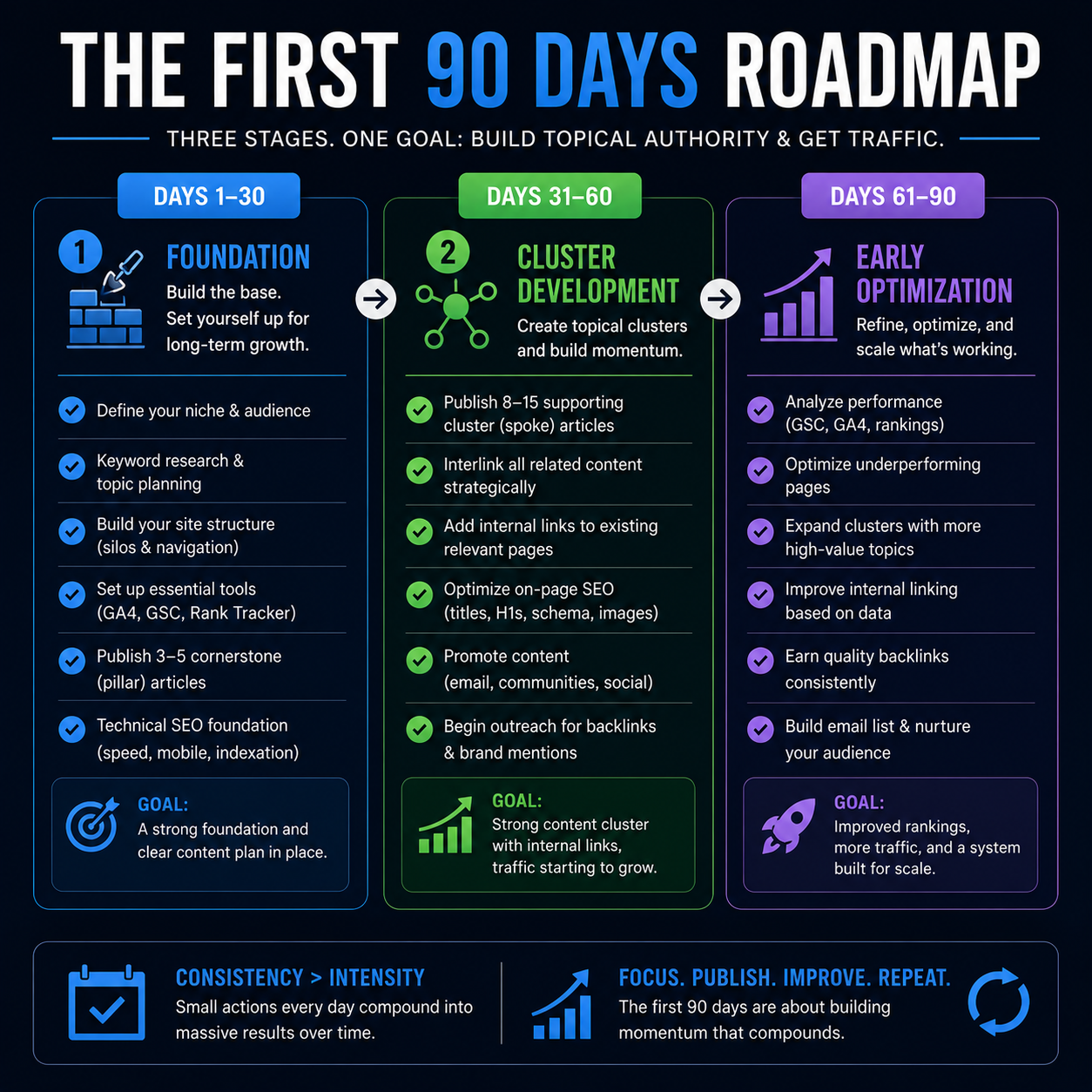
The first 90 days should be about learning quickly, establishing the foundation, and finding signals of traction.
It shouldn’t be a race to publish 100 articles.
Days 1 to 30: Establish the Foundation
During the first month:
- Choose the niche and initial sub-niche.
- Identify realistic monetization opportunities.
- Select the CMS and launch the site.
- Connect Search Console and analytics.
- Create the first hub-and-spoke content map.
- Publish the initial cornerstone pages.
- Set up simple email capture.
- Create the YouTube channel.
- Start checking journalist and outreach opportunities.
Keep the design simple. Your goal is to start gathering information from the market, not impress other website owners with your theme.
Days 31 to 60: Build the First Cluster
During the second month:
- Publish supporting articles around the main hub.
- Record videos based on the strongest topics.
- Embed relevant videos into the written pages.
- Check which pages are indexed.
- Monitor impressions and early rankings.
- Improve weak titles and page structures.
- Begin direct outreach and expert responses.
- Track affiliate clicks, even if sales are still small.
This is where you begin seeing whether the site is being understood.
A page earning impressions at position 60 may not look exciting, but it has entered the conversation. You now have something to improve.
Days 61 to 90: Follow the Early Signals
During the third month:
- Find pages gaining the most impressions.
- Look for queries ranking on pages two through five.
- Improve articles showing early traction.
- Add examples, screenshots, comparisons, or video.
- Expand the most promising subcluster.
- Review affiliate click behavior.
- Continue building links.
- Remove tasks that aren’t supporting the main strategy.
Fail fast and fail often doesn’t mean publish garbage.
It means get useful work into the market, observe what happens, and adjust before wasting a year on the wrong plan.
How to build website authority, win Google traffic, and create an online asset that grows for years on end.
This course is everything I learned along the way, taught in one hour, without the fluff.
Expect Growth to Happen in Steps
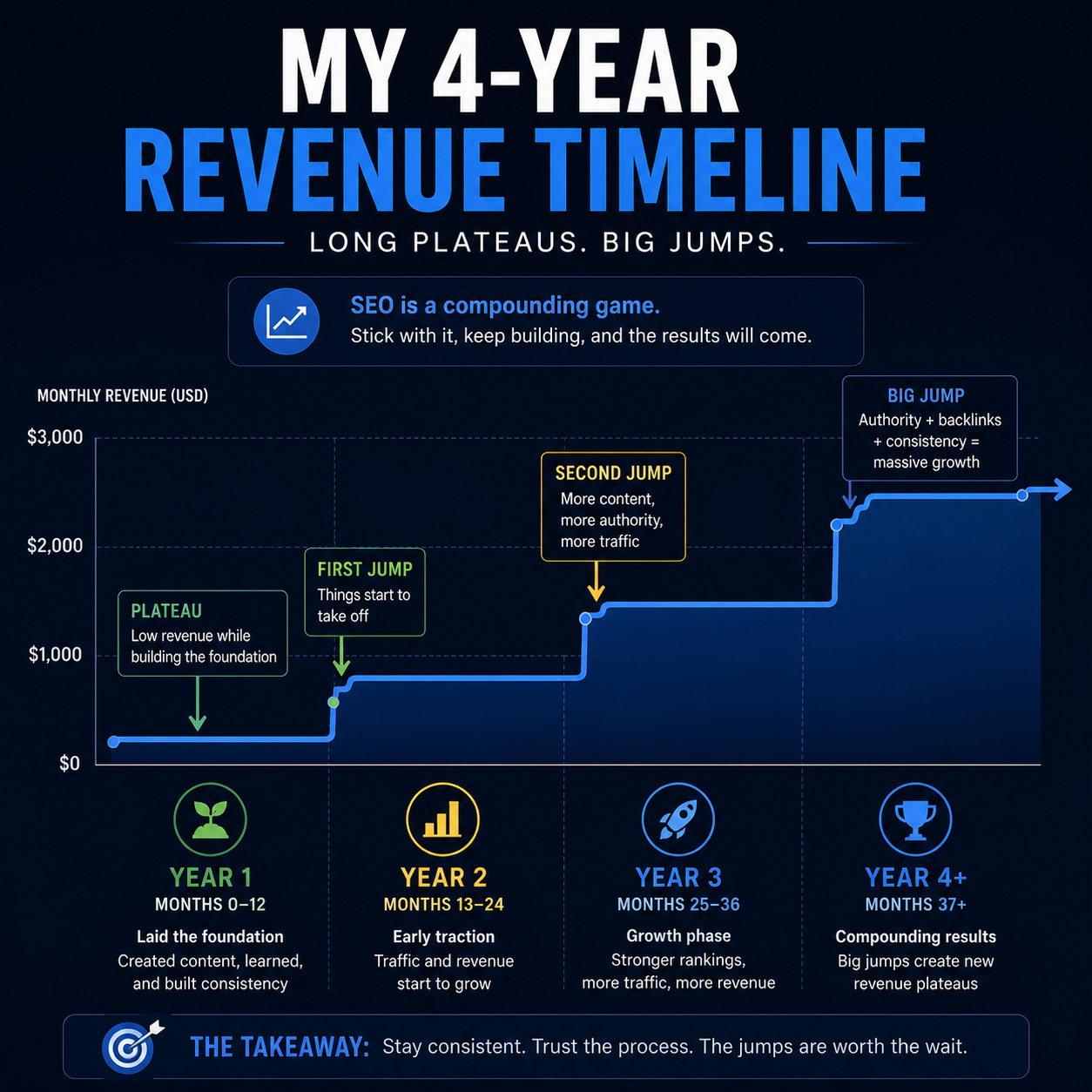
Content-site growth hasn’t been linear for me.
My rough revenue timeline looked like this:
| Stage | Approximate result |
|---|---|
| Month 4 | First $1.22 commission |
| Month 8 | First $100 month |
| Month 12 | Approximately $250 to $500 per month |
| Around month 20 | Approximately $1,000 per month |
| Following 16 months | Mostly $800 to $1,000 per month |
| Recent months | Approximately $2,500 per month |
There were long periods where it looked like very little was happening.
Then revenue jumped. That’s how these businesses often feel from the inside. It’s a whole lot of nothing, then all of a sudden several things work at once.
A group of pages moves up. A strong offer converts. Old content matures. New links begin helping. More people recognize the brand. A video introduces new visitors. Several small improvements combine into a larger result.
This is why I don’t like giving people rigid expectations. Somebody may reach $1,000 per month significantly faster than I did because they begin with better skills, more money, stronger relationships, or a clearer niche. Somebody else may take longer.
Focus on whether the underlying indicators are moving:
- More pages are indexed.
- Search impressions are increasing.
- Average positions are improving.
- Affiliate clicks are appearing.
- Subscribers are joining.
- Visitors are returning.
- Links are being earned.
- Revenue is coming from more than one page.
The first commission proves one page can work.
The next goal is to make it repeatable.
Scale Only After Something Starts Working
Hiring a large writing team too early can create more problems than it solves.
You add fixed expenses before you understand:
- What topics perform
- What voice the audience responds to
- Which offers convert
- Which pages deserve links
- What quality level is required
- Where the actual bottleneck exists
That can leave you with a large library of unfocused content and less money available for distribution.
I’m not against hiring writers.
I hired too early and expected content volume to solve problems it couldn’t solve by itself.
Your next investment should address the next real bottleneck.
That may be:
- Better hosting
- Link acquisition
- An experienced editor
- Original photography
- Product testing
- Video editing
- Technical improvements
- Conversion optimization
- A subject-matter expert
- A writer who can genuinely understand the audience
Don’t hire because a business guru told you to remove yourself from the operation as quickly as possible.
Hire when the system works and another person can help expand it without destroying what made it useful.
One Profitable Asset Can Fund the Next One
My established site gives Digital Whale Club room to develop. It pays for shared tools. It gives me a budget. It allows me to invest without demanding that Digital Whale Club immediately support itself.
That’s a powerful position. It took years to reach it.
I wouldn’t use this as an argument for launching five websites at once. Build one asset that works. Learn from it. Use its cash flow and systems to make the next project better. Digital Whale Club originally struggled because I didn’t completely understand what I was building. The brand was too broad in my head. The strategy wasn’t focused enough. I had content, but I didn’t have a clear cluster or a strong operating direction.
Now I do.
That clarity came partly from operating the other site, watching its revenue grow, and understanding which parts of the process actually matter.
The second site should benefit from the mistakes of the first.
The Biggest Mistakes to Avoid
Here are the mistakes I would try hardest to avoid when building a content site in 2026.
1. Treating the Business as Free to Start
It will cost time, money, or both. Plan accordingly.
2. Choosing a Niche You Can’t Tolerate
The work gets repetitive. Interest gives you a reason to continue when the exciting part wears off.
3. Publishing Without a Monetization Plan
Know how useful attention could eventually become revenue.
4. Producing Disconnected Content
Build one useful cluster before spreading into every category the brand may eventually cover.
5. Hiring Writers Too Early
Don’t create a major fixed expense before understanding the site’s voice, strategy, and economics.
6. Waiting Too Long to Build Links
Publishing and link acquisition should develop together.
7. Relying Entirely on Google
Google can remain a meaningful traffic source, but the brand should also build YouTube, email, direct traffic, and other appropriate channels.
8. Launching Every Platform at Once
Start with the website, YouTube, and email. Expand when the workflow can support it.
9. Using AI to Manufacture Generic Pages
AI should organize and accelerate your expertise, not imitate expertise you don’t have.
10. Expecting Linear Growth
Long plateaus are normal. Revenue often moves in steps.
11. Tracking Traffic Without Tracking Revenue
A page with 100 visitors and five conversions may be more valuable than a page with 10,000 visitors and none.
12. Quitting Before You Understand What Is Working
Don’t confuse slow progress with no progress. Look at the underlying signals before making the decision.
What I Would Do Differently Starting From Zero
If I started another content site from zero today, this is the process I would follow:
- Choose a topic I could discuss for several years.
- Validate the products, services, and affiliate economics.
- Start with one focused topical cluster.
- Set up Search Console and tracking immediately.
- Publish useful written content first.
- Turn the strongest articles into YouTube videos.
- Capture email subscribers from day one.
- Start looking for links immediately.
- Keep the website and video production simple.
- Use AI to accelerate my own thoughts and experience.
- Track affiliate clicks, conversions, expenses, and cash flow.
- Reinvest based on the next actual bottleneck.
I wouldn’t spend all my money on content.
I wouldn’t wait two years to start YouTube.
I wouldn’t assume more articles automatically create more authority.
I also wouldn’t set an arbitrary deadline for the business to succeed.
I would build, measure, learn, and adjust.
Build a Business, Not a Blog
Content sites are still worth building in 2026.
The opportunity belongs to people willing to treat them like businesses.
That means accepting that the process costs money. It means learning difficult skills, building links, understanding search intent, testing monetization, publishing useful content, and meeting people across more than one channel.
It also means giving readers information that couldn’t have come from anybody else.
My first dollar online was $1.22. It took around eight months to reach $100 in a month and almost four years to reach the site’s current level of approximately $2,500 per month.
That wasn’t fast.
It was valuable.
The site now generates cash flow, gives me a platform, and helps fund the next asset I’m building.
That’s what profitability gives you. It doesn’t just put money in your account. It gives you time, options, experience, and the ability to build the next thing more intelligently.
Start small. Keep your costs visible. Build one focused area at a time. Create content that sounds like a real person. Start collecting an audience before you think you need one.
Most importantly, stay in the game long enough to understand what you’re actually building.